Repair
Wolf wall ovens in Mandarin that run cold or lock themselves shut
A wall oven is boxed into cabinetry with a few inches of air around it, so most of what fails is either thermal, mechanical at the door, or downstream of a clean cycle.
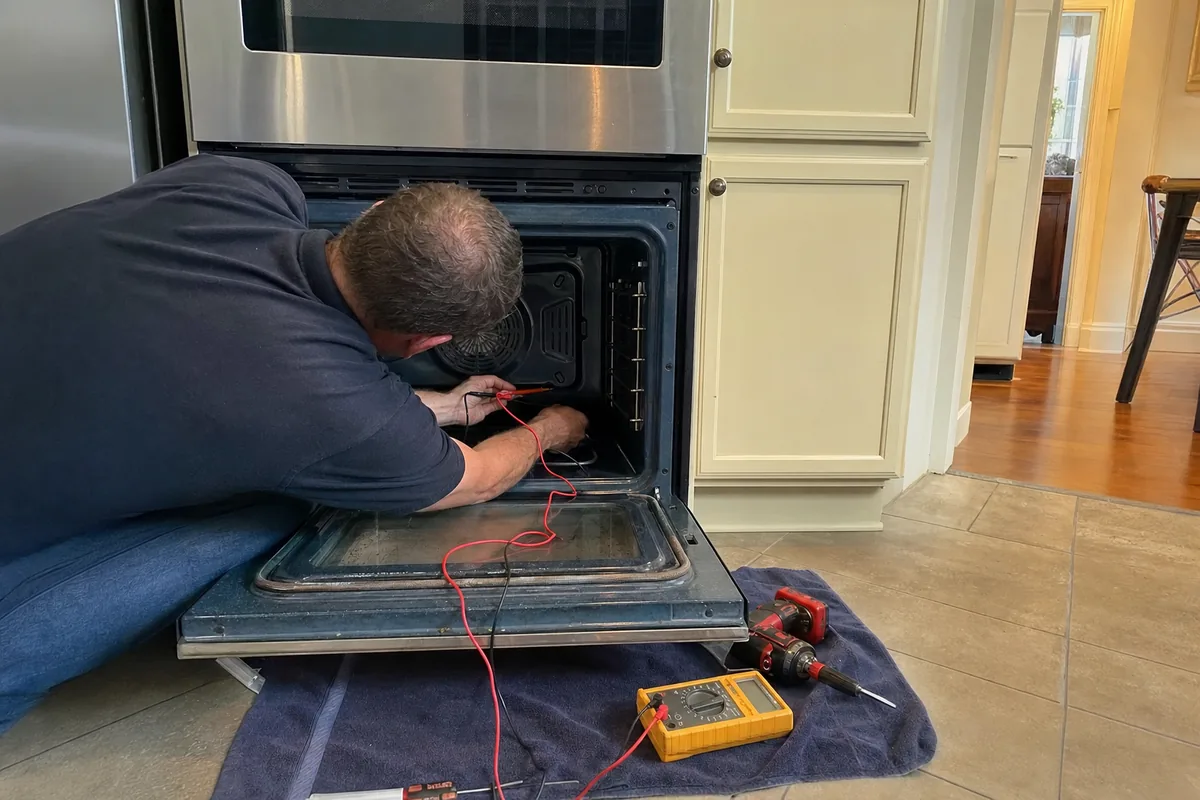
What people describe when they call
- The oven takes far longer than it used to reach temperature
- Food browns on one side of the tray and not the other
- The display went blank or dead at the end of a self-clean cycle
- The door will not latch, or latched itself and will not release
- The convection fan makes a rattling or grinding noise while it runs
- The oven light stays on or will not come on at all
What the visit involves
- Put a measured thermometer in the cavity and compare it with the setpoint
- Test the temperature sensor cold and hot rather than replacing it on suspicion
- Check the element for a partial break instead of assuming it is fine because it glows
- Inspect the door seal, hinges and latch as one system, because they fail as one
- Check the thermal fuse and the wiring behind the control after a clean cycle
- Give you the price in writing before a part is ordered
Kitchen cooking appliances, and only those. Not home heating · air conditioning · heat pumps · HVAC ductwork · water heaters · refrigeration · dishwashers · laundry.
A built-in oven lives inside cabinetry, which changes it in two ways that matter to a repair. It has only a few inches of air on each side to get rid of its own heat, and everything that fails is behind a face frame rather than out in the open. Neither is a problem in itself. Both mean that installation faults and component faults produce similar symptoms, and that it is worth ruling out the cheap possibility before buying the expensive one.
Running cold, running uneven
An oven that no longer reaches temperature in the time it used to is doing one of two things. It is making less heat, or it is losing heat faster. Nothing else. From standing in the kitchen the two feel identical, which is why so many people replace a part that was never the problem.
Making less heat usually means an element that has opened partway along its length, or a sensor that has drifted. A partly failed element still glows, still feels hot, still looks entirely convincing, and does perhaps two-thirds of the work. A drifted sensor is worse in a way, because there is nothing to see at all. It simply tells the control the cavity is hotter than it is, and the control does exactly what it is supposed to do with that bad information, which is stop heating early.
Losing heat means the door. A seal that has hardened and taken a set stops touching in one section. A hinge that has weakened lets the door sit a fraction proud at the top while still latching firmly at the bottom. Either one opens a gap you can find with the back of your hand while the oven is hot, and either one costs fifteen or twenty degrees.
Uneven browning is a third thing again and is usually about air rather than heat. A convection fan that is turning slowly, a baffle that has been reinstalled in the wrong orientation after a clean, or racks loaded so tightly that air cannot travel will all brown the front and neglect the back.
After a self-clean cycle
If an oven goes dark at the end of a clean cycle, or during the hours after it, that is a recognisable pattern rather than a coincidence. A clean cycle runs the cavity far hotter than any cooking ever does, and the heat has to go somewhere. The parts closest to that heat are the ones that suffer: the thermal fuse, which is designed to sacrifice itself and often does exactly that, the door latch motor, and the wiring and connectors immediately behind the control panel.
We check those in that order, because a blown thermal fuse is a modest part and a control board is not, and the fuse frequently explains everything.
The practical advice that follows is worth taking. Run a clean cycle when you do not need the oven the next day, run it with the kitchen ventilated, and do not run it back to back.
The door as a single system
Seal, hinges and latch fail together often enough that we treat them as one assembly. A weak hinge lets the door hang differently, which loads one part of the seal harder than the rest, which flattens that section, which lets heat out, which cooks the hinge grease, which weakens the hinge further. By the time somebody calls, the original cause is often no longer the biggest problem.
Storms, and the local part of this
Around sixty-eight thunderstorm days a year is enough that we treat control board damage in Mandarin as an ordinary repair rather than an unlucky one. If an oven stopped working during or shortly after a storm, that is worth saying on the phone, because it changes what we bring with us.
The other local factor is the cutout. A great many Mandarin wall ovens were fitted into cabinetry built decades before the appliance, and clearance around the box is often tighter than it should be. An oven that overheats its own electronics because it cannot breathe will fail again after any repair, so we would rather find that on the first visit than the third.
What does built-in oven repair repair cost in Mandarin?
The diagnostic is $80, flat, and it comes off the bill. After that, the repairs we are actually called out to in Mandarin land between $180 and $700, parts and labour together. The firm figure is written down after the diagnosis and before anything is ordered.
| What turned out to be wrong | Usual range |
|---|---|
| Diagnostic visit | $80 flat, credited |
| Oven thermostat or temperature sensor | $180–$560 |
| Convection fan or motor | $270–$700 |
| Door hinge, glass or seal | $190–$680 |
Ranges, not quotes. Two ovens with the same symptom can part company on the part number, and a retrofit opening can add an hour before a tool comes out of the bag. Nothing is ordered until the figure is in writing. The whole price page sets out how a job is priced.
Questions people ask about built-in oven repair
- How much does built-in oven repair repair cost in Mandarin?
- The visit and the diagnosis are $80 flat, and that comes off the bill if you go ahead. Oven thermostat or temperature sensor then usually lands at $180–$560, parts and labour together. Convection fan or motor runs $270–$700. You get the figure in writing before a part is ordered.
- Is it worth repairing, or should the built-in oven repair be replaced?
- On a built-in appliance the honest answer is usually repair, because replacing one means matching a cabinet opening, a gas run, a duct and a circuit that were all built around the old machine. We say so when a repair stops making sense, and we say it before you spend.
- Will you have the part on the van?
- Often, because the van is stocked for one make. Igniters, sensors, seals and common elements ride with us. A control board or a cosmetic panel is ordered in, and the second visit to fit it carries no new diagnostic fee.
Where this comes up most
The parts of the service area where this fault turns up often enough to be worth a page of its own.
- Wolf ranges retrofitted into Mandarin kitchens drawn for something smallerMandarin · 32223
- Wolf wall ovens in Beauclerc, sitting in cabinetry that predates themBeauclerc · 32257
- Wolf ranges and built-in ovens in 1990s Julington Creek kitchensJulington Creek · 32223
Notes on this
Longer reading on the same faults, written in plain words.
- Gas versus electric Wolf ovensFlame or element decides more than flavor: it changes how the cavity holds heat, whether the oven can clean itself, and which parts wear out first. A side-by-side for Wolf owners choosing between the two.
- Circuitry errors on Wolf ovensA circuitry message points behind the control panel, not at the heating parts. What sets it off, the one reset worth trying, the look-alike messages that are not faults, and when a meter has to settle it.
- An oven that will not heat at allThe oven wakes up, the display behaves, the fan runs, and an hour later the cavity is still cold. That is a different fault from an oven that merely runs cold, and it is usually found before a part is ordered.
- An oven that runs coldThere are only two ways an oven can run cold. It is making less heat than it should, or it is losing heat faster than it should, and telling them apart is most of the job.
- Storms and control boardsA board almost never dies from a direct hit. It dies from the smaller events either side of one, and the failure often arrives days after the storm that caused it.
- Parts, serial numbers and waitingThe most useful photograph you can send us is not the fault. It is the rating plate, because the model and serial on it decide which version of a part the appliance takes and whether it is on the van already.
What owners said about built-in oven repair
4.6 out of 5 from 75 published reviews
The bottom cavity of the double oven worked and the top did nothing at all. He traced it to a burnt connection behind the trim, redid the terminal properly and checked the draw on both cavities before leaving.
Colin B.
The wall oven quit part way through a roast and threw no code at all. He traced it to a scorched terminal block sitting behind the trim rather than the control board I was braced to pay for. It was back in service on the same visit.
Yvette D.
Oven door had dropped about a finger width on the left and the seal stopped meeting the frame. New hinge on that side, then he levelled the whole unit in its opening and showed me the gap closing.
Odessa N.
Tell us what the range is doing
Describe the symptom in your own words. If it is something you can put right in ten minutes at the panel, we will say so on the phone and there is nothing to pay.
A flat $80 covers the visit and the diagnosis, and it comes off the bill if you go ahead with the repair.
You get the price in writing before any part is ordered or any tool comes out of the bag.
Labour is warranted for 90 days and parts for 365 days, and the parts are genuine OEM.
Monday to Friday, 8:00am to 6:00pm. Saturday, 9:00am to 4:00pm. Closed Sunday.