Duval County · 32223
Wolf ranges retrofitted into Mandarin kitchens drawn for something smaller
Home ground. Beauclerc, Loretto, Julington Creek and the riverfront lots along Mandarin Road, where a large range is usually a retrofit rather than a fit.
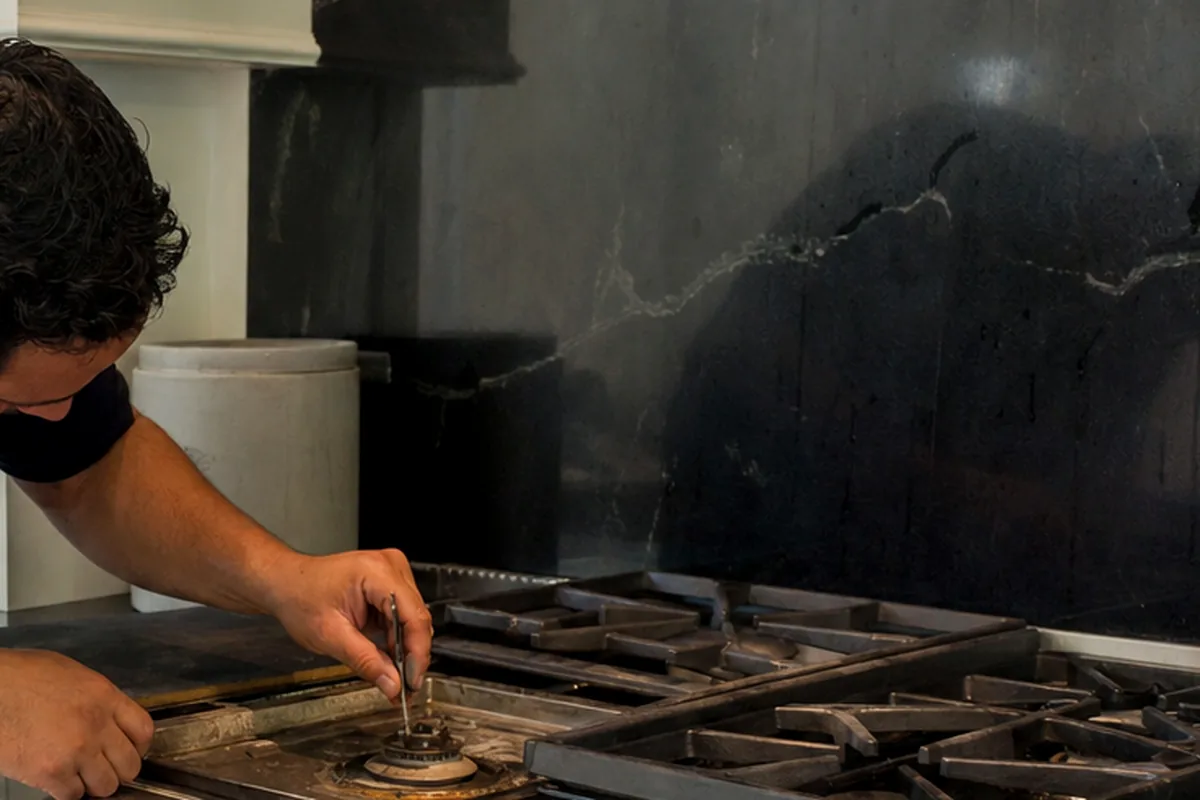
What is true of Mandarin and nowhere else
- Mandarin took its name from the Mandarin orange in 1830, and Harriet Beecher Stowe wintered here, which is why the oldest lots along the river are deep and irregular rather than laid out on a grid.
- Most of the housing stock is established 1970s to 1990s subdivisions on generous lots, with riverfront estates along Mandarin Road, so a large range is very often a retrofit into an opening that was never sized for it.
- Because so many kitchens here were adapted rather than designed around the appliance, we check the opening, the level, the circuit and the gas run before condemning a part, and it changes the answer often enough to be worth the time.
Streets and communities we work in
Beauclerc · Loretto · Julington Creek · Cormorant Landing · Cormorant Creek Estates · Egrets Landing · Julington Hills · Lake Mandarin · Gates of Olde Mandarin · River Story
What we are not the people to ring in Mandarin about
This is a kitchen trade: cooking appliances, built in. Home heating, air conditioning, heat pumps and the ducted systems that serve the rest of the house are somebody else's work, and we say so rather than take the call. In Mandarin that means the range, the rangetop, the built-in oven and the hood over the cooking surface — and nothing beyond the kitchen. A cooker hood has a duct of its own, and that duct is the only one we ever open. It is not part of the heating and air-conditioning system, we do not work on that system, and a hood problem is never a reason to ring us about the rest of the house.
Not us, in Mandarin or anywhere else: home heating · air conditioning · heat pumps · HVAC ductwork · water heaters · refrigeration · dishwashers · laundry.
Mandarin is where this shop is based, so almost everything here is a short drive. That has a practical effect on how the work goes rather than just being a pleasant thing to say: it means we can come back the same week with a part without the second visit costing anybody a day.
The order we work in
We check things in a fixed order, and the order is not the one most people expect. It starts at the supply and works inwards, because the further out the fault is, the cheaper it is to find and the more expensive it is to miss.
So the first questions are about the house. Is the appliance on its own circuit or sharing one. Does anything else in the kitchen misbehave at the same moment. Is the gas line delivering what the appliance asks for when several burners and an oven are all working, rather than when one burner is lit. Is the range level and is the opening square.
Only then do we look at the appliance, and inside it we start with the parts that are designed to fail first — fuses, thermal cutouts, protective devices. When one of those has done its job it usually explains the whole fault, and replacing something expensive without finding out why it died simply buys the same failure again a few months later.
The board, the element or the valve comes last. It is the part everyone suspects first, and it is genuinely the answer often enough — but only after the cheaper explanations upstream of it have been ruled out.
What the houses do
The subdivisions here mostly went up between the 1970s and the 1990s, and kitchens from that period were not planned around a forty-eight inch range. When one goes in, three things become part of the job rather than afterthoughts: the cabinet opening has to be widened cleanly, the floor under it has to carry the weight without flexing, and the oven side needs its own circuit rather than a share of one.
We see the consequences of shortcuts on all three. A floor that gives a little shows up as a door that will not stay square. A shared circuit shows up as an oven that resets when something else in the kitchen starts. Neither of those is a fault in the range, and it is worth knowing that before parts get replaced.
When the right answer is not us
There are calls we turn down, and it is better to say why here than on the doorstep.
If the appliance is still inside its original manufacturer warranty, ring the manufacturer first. We will tell you that on the phone rather than take the booking, because work done by an independent shop during that period can affect what the maker will cover afterwards.
If the problem is upstream of the appliance, it belongs to a different trade. Gas beyond the appliance connection is the utility’s or a licensed plumber’s. House wiring, a shared circuit or a panel that needs a new run is an electrician’s. A hood that cannot move air because the duct is wrong, or because the house is too tight to give it replacement air, is a ductwork and building problem, and no part we could fit would change it.
We will still tell you what we found and what we think it needs. What we will not do is sell you a repair that was never going to fix the complaint, which is the fastest way we know to lose a customer we would rather keep.
What we do not do
We work on Wolf cooking appliances and nothing else. That is a deliberate limit rather than a shortage of ability. Ranges, rangetops, cooktops, built-in ovens, convection steam ovens, speed ovens, warming drawers and ventilation are what this shop carries parts and test gear for, and it is where thirty years of pattern recognition is actually worth something to you.
We are an independent shop. We are not sent by the manufacturer and we do not represent them, and we would rather say that at the start of a conversation than have anybody assume otherwise.
Storms
Around sixty-eight thunderstorm days a year is enough that control board damage is an ordinary repair here rather than a rare one. If a range went dark during a storm and has not come back, say so when you call — it changes what we bring.
The failure does not always arrive on the day. A component weakened by a brief overvoltage will often keep working for a week or two and then give up during an ordinary heat cycle, so the storm and the fault do not look connected from the kitchen. If anything stopped working in the fortnight after a storm, that is worth mentioning even if you are not sure the two are related.
What does a repair in Mandarin cost?
The diagnostic is $80, flat, and it comes off the bill. After that, the repairs we are actually called out to in Mandarin land between $180 and $700, parts and labour together. The firm figure is written down after the diagnosis and before anything is ordered.
| What turned out to be wrong | Usual range |
|---|---|
| Diagnostic visit | $80 flat, credited |
| Igniter or spark module replacement | $200–$510 |
| Burner valve or orifice service | $220–$700 |
| Oven thermostat or temperature sensor | $180–$560 |
| Convection fan or motor | $270–$700 |
Ranges, not quotes. Two ovens with the same symptom can part company on the part number, and a retrofit opening can add an hour before a tool comes out of the bag. Nothing is ordered until the figure is in writing. The whole price page sets out how a job is priced.
Questions from Mandarin kitchens
- Do you cover Mandarin?
- Yes. Mandarin, Jacksonville is home ground and Mandarin (32223) is inside the 25 miles we work. Monday to Friday, 8:00am to 6:00pm. Saturday, 9:00am to 4:00pm. Closed Sunday. If you are further out than that we say so on the phone instead of taking the booking and sorting it out later.
- What does a repair in Mandarin cost?
- The visit and the diagnosis are $80 flat, and that comes off the bill if you go ahead. Igniter or spark module replacement then usually lands at $200–$510, parts and labour together. Burner valve or orifice service runs $220–$700. You get the figure in writing before a part is ordered.
- Do I need the model number before I ring?
- No. A symptom in plain words is enough to start. The plate is usually behind the bottom drawer or inside the door frame, and reading it out saves a little time on the phone, but it is not a condition of the call.
What we are usually called out to in Mandarin
- Wolf dual fuel ranges in Mandarin: gas on top, electric below, two sets of faultsA gas cooktop over an electric oven means two different sets of faults in one appliance, and they rarely fail at the same time or for the same reason.
- Wolf gas range igniters in Mandarin that glow without ever lighting the burnerAn all-gas range puts a flame in the oven as well as on the top, which means the oven has a safety valve, and that valve is behind most of the slow-oven calls we take.
- Wolf induction zones in Mandarin and Loretto that cut out under loadAn induction range has no flame and no glowing coil, so when a zone stops working the fault is either the pan, the cooling path or the electronics under the glass.
- Wolf rangetop burners in Mandarin that click and will not lightA rangetop drops into the counter with cabinetry underneath, so everything that fails is within arm's reach once the grates and burner bowls come off.
- Wolf wall ovens in Mandarin that run cold or lock themselves shutA wall oven is boxed into cabinetry with a few inches of air around it, so most of what fails is either thermal, mechanical at the door, or downstream of a clean cycle.
- Wolf steam ovens in Mandarin that say the reservoir is emptyA steam oven boils water and then lets it stand, so it fails in ways a dry oven never does — reservoir sensors, narrow passages, drains and gaskets that seal against moisture as well as heat.
- Wolf cooker hoods in Mandarin that run but clear almost nothingA hood only does its job if the air it collects actually leaves the house, so half of what looks like a hood fault turns out to be a duct fault instead.
Reading that applies here
Streets nearby
- Loretto32223
- Julington Creek32223
- Mandarin Road32223
What Mandarin owners said
4.6 out of 5 from 75 published reviews
The charbroiler had stopped lighting at one end. He cleared a blocked port, changed the igniter on that side and ran it up to full to be sure it stayed lit before writing anything down.
Clementine J.
Left front burner kept lighting and then dropping out, but only once the oven was going. Turned out to be a cracked igniter plus a loose ground at the back. He showed me both before touching anything, and the range has been steady since.
Dana K.
Wall oven kept losing temperature halfway through a bake and the display never said a word about it. He put his own probe in, caught the drift and changed the sensor rather than selling me a board I did not need.
Marguerite T.
Tell us what the range is doing
Describe the symptom in your own words. If it is something you can put right in ten minutes at the panel, we will say so on the phone and there is nothing to pay.
A flat $80 covers the visit and the diagnosis, and it comes off the bill if you go ahead with the repair.
You get the price in writing before any part is ordered or any tool comes out of the bag.
Labour is warranted for 90 days and parts for 365 days, and the parts are genuine OEM.
Monday to Friday, 8:00am to 6:00pm. Saturday, 9:00am to 4:00pm. Closed Sunday.