Repair
Wolf gas range igniters in Mandarin that glow without ever lighting the burner
An all-gas range puts a flame in the oven as well as on the top, which means the oven has a safety valve, and that valve is behind most of the slow-oven calls we take.
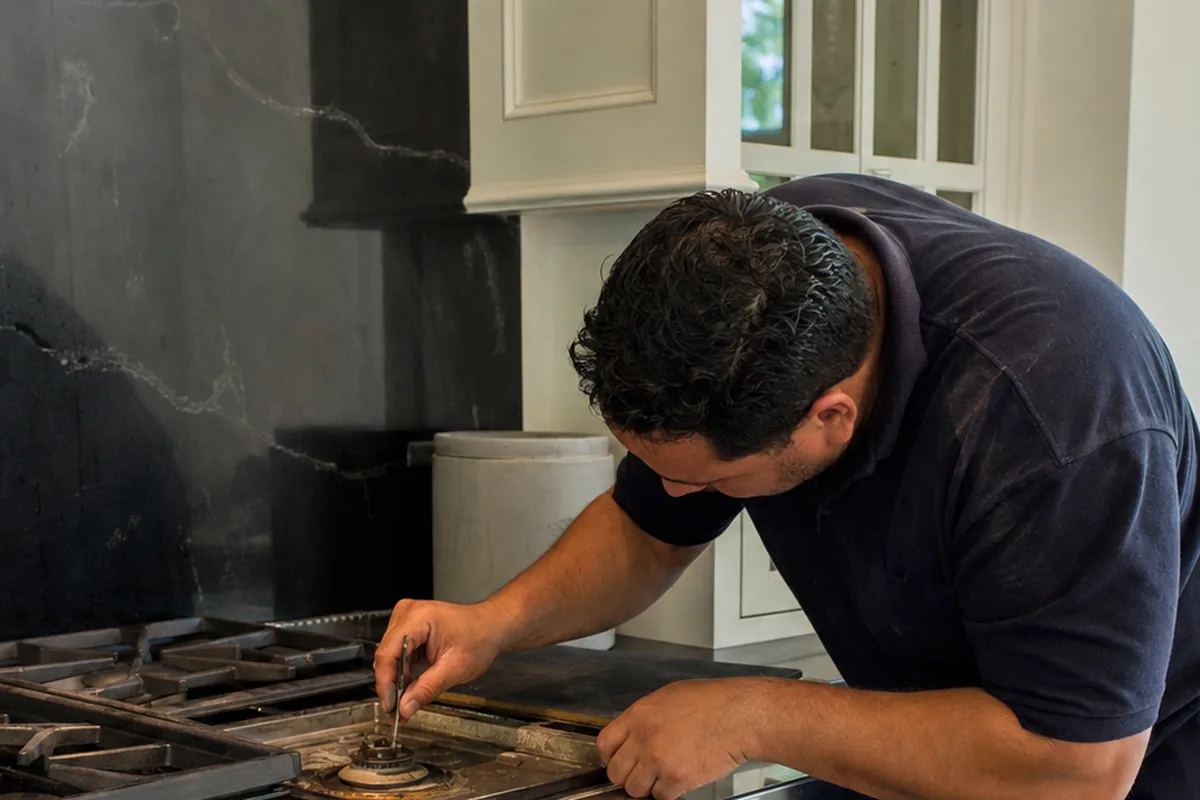
What people describe when they call
- A surface burner clicks and clicks but never catches
- The oven igniter glows orange and the burner under it never lights
- The oven takes half an hour to reach a heat it used to reach in twelve minutes
- One burner burns yellow and lazy while the others burn blue
- The simmer setting will not stay lit and drops out on its own
- There is a smell of gas near the range when nothing is turned on
What the visit involves
- Confirm the fault standing in your kitchen before anything is quoted
- Measure what the oven igniter is actually drawing rather than judging it by how bright it looks
- Check gas pressure at the appliance itself instead of taking the meter's word for it
- Clear and reseat burner ports and caps and check the gap at every electrode
- Compare a measured cavity temperature against the heat the control is calling for
- Put the price in writing before a part is ordered or a tool comes out of the bag
Kitchen cooking appliances, and only those. Not home heating · air conditioning · heat pumps · HVAC ductwork · water heaters · refrigeration · dishwashers · laundry.
An all-gas range burns fuel in two places, and that is the useful thing to hold in your head when something goes wrong with one. The top is the part everybody thinks about, but the oven has a burner of its own down at the bottom of the cavity, hidden under a floor panel, and it is protected by a safety valve that will not open until the oven has proved to itself that there is something down there hot enough to light gas. That protection is sensible and it is also the single most common reason a gas oven starts behaving strangely as it gets older.
The oven that glows but will not light
Almost every gas oven made in the last forty years uses a glow bar. It is a ceramic element that heats until it is bright orange, and the safety valve is wired in series with it. The valve does not watch for light. It watches for current. When enough current is flowing through the glow bar, the valve knows the bar must be hot, and it opens.
A glow bar ages by losing conductivity. It still lights up. It still looks exactly the way it looked on the day it was installed. But it now draws a little less current than the valve needs to see, and the valve holds shut. What you get from the kitchen is an oven that sits there glowing, smelling faintly of nothing, and never coming up to heat. Or, in the earlier stage of the same fault, an oven that eventually lights but takes two or three minutes to do it and then runs behind all afternoon.
You cannot judge this by eye, which is why we put a meter on it. A glow bar either passes the current the valve requires or it does not, and that measurement takes a couple of minutes and settles the question completely.
The top burners
A single burner that clicks without catching is almost always a local problem rather than a supply problem. Something boiled over and dried in a port. A cap went back on a fraction out of true after a clean and is now sitting proud of its seat, so the spark is jumping to the wrong place. An electrode has picked up a film of grease and is arcing weakly. All three are small jobs.
If every burner on the range clicks and none of them light, the question moves upstream and becomes a supply question. We check the pressure at the appliance rather than assuming the meter is delivering what it should, because a regulator that has drifted low will starve a large range long before a smaller gas appliance anywhere else in the house notices anything at all.
A burner that burns yellow instead of blue is telling you the air-to-gas ratio is wrong. Yellow means not enough air, and it leaves soot on the bottom of a pan that you can rub off with a finger. That is worth attending to promptly, not because it is dangerous in the short run but because incomplete combustion is never the appliance working as designed.
The simmer that will not hold
Wolf burners are built to hold a very low flame, and a low flame is a fragile thing. It has less heat to defend itself with. When a simmer setting drops out on its own after a minute or two, the usual causes are a partly blocked port on the inner ring, a slightly low supply pressure that is fine at full rate and marginal at the bottom of the range, or a valve that is no longer metering smoothly at the very end of its travel.
What Mandarin adds to all this
A gas range in a 1970s or 1980s Mandarin kitchen is very often a retrofit into an opening built for something narrower, and retrofits mean flexible connectors, shutoff valves in awkward places, and gas runs that were sized decades ago for a smaller appliance. When a range is starved at full output but perfectly happy at half, the line rather than the range is usually the thing to look at first.
If you smell gas at any time, turn the range off at the shutoff, open a window, and call the gas utility before you call us. That is not a repair, it is a safety matter, and it has an order of operations.
What does gas range repair repair cost in Mandarin?
The diagnostic is $80, flat, and it comes off the bill. After that, the repairs we are actually called out to in Mandarin land between $180 and $700, parts and labour together. The firm figure is written down after the diagnosis and before anything is ordered.
| What turned out to be wrong | Usual range |
|---|---|
| Diagnostic visit | $80 flat, credited |
| Igniter or spark module replacement | $200–$510 |
| Burner valve or orifice service | $220–$700 |
| Oven thermostat or temperature sensor | $180–$560 |
Ranges, not quotes. Two ovens with the same symptom can part company on the part number, and a retrofit opening can add an hour before a tool comes out of the bag. Nothing is ordered until the figure is in writing. The whole price page sets out how a job is priced.
Questions people ask about gas range repair
- How much does gas range repair repair cost in Mandarin?
- The visit and the diagnosis are $80 flat, and that comes off the bill if you go ahead. Igniter or spark module replacement then usually lands at $200–$510, parts and labour together. Burner valve or orifice service runs $220–$700. You get the figure in writing before a part is ordered.
- Is it worth repairing, or should the gas range repair be replaced?
- On a built-in appliance the honest answer is usually repair, because replacing one means matching a cabinet opening, a gas run, a duct and a circuit that were all built around the old machine. We say so when a repair stops making sense, and we say it before you spend.
- How long is the work covered for?
- Labour is warranted for 90 days and parts for 365 days, and the parts are genuine OEM. The cover is on the work we did and the part we fitted, not on a different fault that turns up later on the same appliance. Ring and say it is a warranty call: there is nothing for you to produce.
Where this comes up most
The parts of the service area where this fault turns up often enough to be worth a page of its own.
Notes on this
Longer reading on the same faults, written in plain words.
- Gas versus electric Wolf ovensFlame or element decides more than flavor: it changes how the cavity holds heat, whether the oven can clean itself, and which parts wear out first. A side-by-side for Wolf owners choosing between the two.
- An oven that runs coldThere are only two ways an oven can run cold. It is making less heat than it should, or it is losing heat faster than it should, and telling them apart is most of the job.
- A burner that clicks and will not lightThe most useful thing you can tell us about a burner that will not light is how many of its neighbours are doing the same thing, because that single fact splits the diagnosis.
What owners said about gas range repair
4.6 out of 5 from 75 published reviews
The small burner would not stay low enough to hold a sauce without going out. He set it properly and explained why the flame was lifting off the port instead of just telling me it was fixed.
Fiona L.
Two burners were lighting slowly and gave off a smell of gas for a second before they caught. He cleaned and reset the ports and swapped one spark module. It took a second trip because the module was not on the van, but he rang ahead both times.
Curtis M.
Oven in the range would bake but never brown. He found the broil element open circuit, fitted a new one, and pointed out the rack position we had been using was half the problem.
Ambrose T.
Tell us what the range is doing
Describe the symptom in your own words. If it is something you can put right in ten minutes at the panel, we will say so on the phone and there is nothing to pay.
A flat $80 covers the visit and the diagnosis, and it comes off the bill if you go ahead with the repair.
You get the price in writing before any part is ordered or any tool comes out of the bag.
Labour is warranted for 90 days and parts for 365 days, and the parts are genuine OEM.
Monday to Friday, 8:00am to 6:00pm. Saturday, 9:00am to 4:00pm. Closed Sunday.