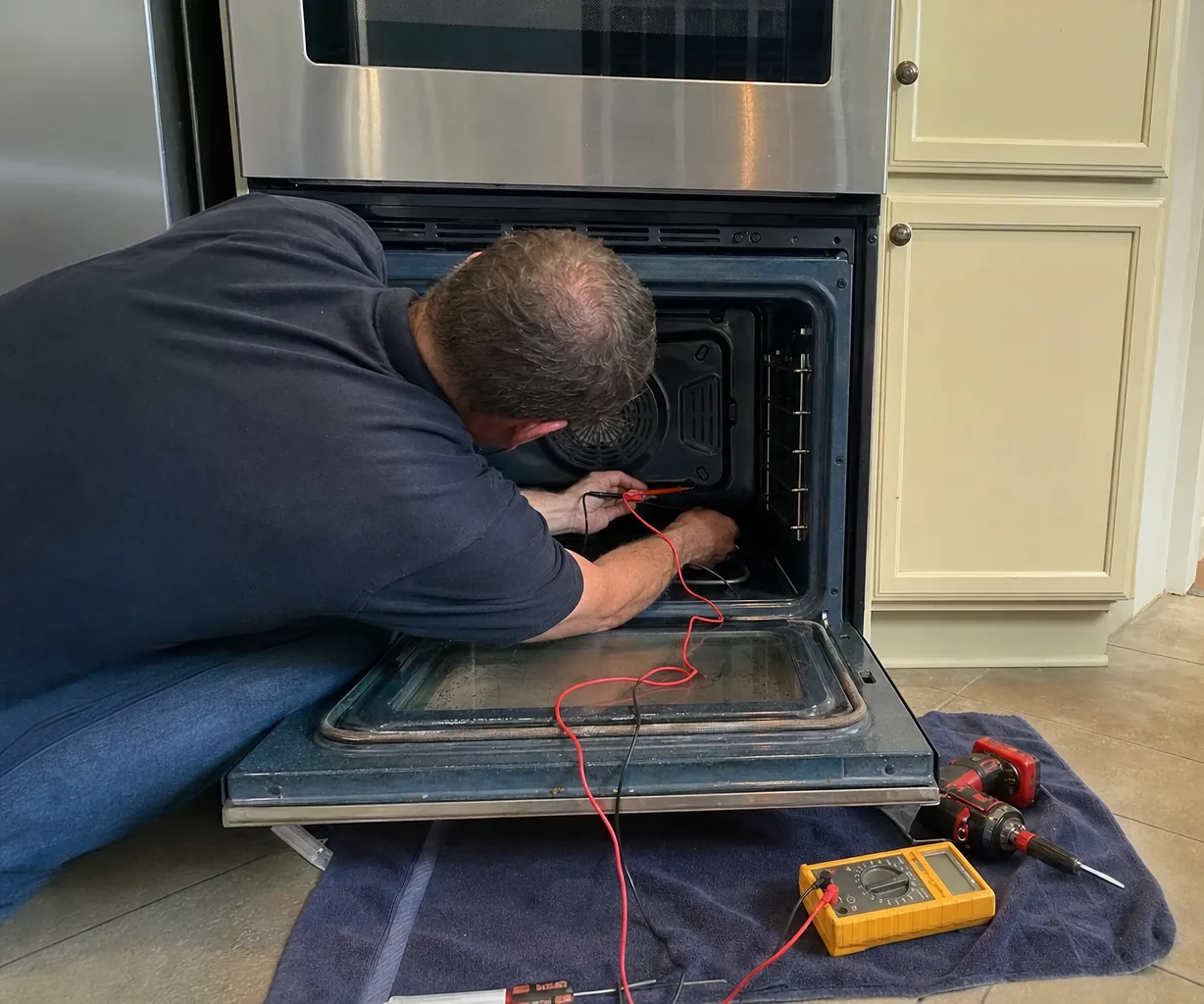
A gas oven heats with a burner flame, which gives fast, slightly humid heat and a simple ignition system, but it cannot clean itself. An electric oven heats with elements and, usually, a fan, so it holds a set temperature more tightly, offers more cooking modes and runs a self-clean cycle, in exchange for more sensors and electronics. In a Wolf kitchen the decision usually lands on a GR gas range, a DF dual fuel range with a gas top over an electric oven, or an electric wall oven, and each of those cooks, cleans and fails a little differently.
Where the heat comes from
A Wolf gas oven has two burners. On GR ranges, the 30-inch and 36-inch ovens carry a 30,000 Btu bake burner under the floor and an 18,000 Btu broil burner at the top, while the small 18-inch oven bakes on a single 18,000 Btu burner and has no broiler. Propane models keep the same output. The oven dial covers 150°F-500°F, plus Broil.
Burning gas releases water vapor, so a gas cavity always holds a little moisture. That suits a roast or a rising loaf, and helps less when you want a very dry, crisp finish.
An electric oven works with hidden elements for bake and broil and, on convection models, a fan with its own ring of heat behind the back wall. The air stays dry, and the control cycles the elements against a temperature sensor, keeping the swing around your set point small.
What you notice when you cook
The bigger difference for most owners is how many things the oven can do. A Wolf M Series electric oven offers ten modes: Bake, Roast, Broil, Convection Roast, Convection, Gourmet, Proof, Stone, Dehydrate and Warm, with Stone and Dehydrate needing accessories. On E Series double ovens, the lower cavity skips Convection, Gourmet, Stone and Dehydrate, worth knowing if you plan to bake in both at once.
A gas oven keeps things simpler: bake and broil, set by a knob. People who mostly roast and broil rarely miss the extra modes; people who bake several trays at once or proof dough usually do.
Cleaning, and why only one has a door lock
Wolf gas ranges do not self-clean. They have no door lock, and a flame-heated cavity never reaches the temperatures above 900°F that a proper pyrolytic clean depends on. Every Wolf electric oven, by contrast, includes a self-clean cycle.
On an M Series oven that cycle runs for roughly four hours with the interior lights switched off, and the door stays latched until the cycle has finished and the cavity has dropped under 550°F (290°C). On a double oven, the second cavity is out of use the whole time. Run it a few days before a holiday meal, not the morning of.
That lock is also a moving part, and a latch stuck shut after a clean is a fault no gas oven can have.
How each one tends to fail
Gas ovens fail around ignition. A hot-surface igniter has to glow and draw enough current to open the safety valve; as it weakens it still glows but never lets gas through, so the oven looks busy and stays cold. A gas oven also has to match its fuel: the serial tag and rating plate say NG (or NAT) or LP, and a converted unit should carry a sticker beside the original tag naming the new gas.
Electric ovens fail around the parts a gas oven lacks: elements, the temperature sensor, the convection fan motor, the door lock and the control board.
| Symptom | Likely cause | What you can check | When to call |
|---|---|---|---|
| Gas oven glows but stays cold | Weak igniter | Do the surface burners light? | If the glow lasts minutes with no flame |
| Electric oven runs cool | Sensor or element | An oven thermometer on the center rack | If well off after full preheat |
| Door stays locked after a clean | Lock motor or switch | Cool fully, cycle the breaker | If it is still locked once cold |
| Fan silent on convection | Fan motor | Listen with the door shut | If only convection fails |
For a slow-to-heat oven, see an oven that runs cold.
Service, parts and typical costs
Either type starts with an $80 diagnostic. After that, typical ranges look like this, with the firm figure given once the fault is confirmed: an igniter or spark module usually falls in $200–$510, an oven thermostat or temperature sensor in $180–$560, a door hinge, glass or seal in $190–$680, and a control board or touch panel in $430–$1,080.
The serial number decides which part fits. On GR and DF ranges, open the oven door and look at the bottom of the control panel, far right. On SO3050/DO3050 wall ovens it sits near the bottom trim on the left with the door open, on the lower oven of a double.
Choosing for your own kitchen
Start with what is already at the wall. If your Mandarin kitchen has no gas line where the range stands, an electric wall oven, single (SO) or double (DO), avoids new piping entirely. If you love a flame on top but want an even, self-cleaning oven below, a dual fuel range splits the difference, though it brings both sets of parts into one appliance. And if you choose gas, a working hood matters more, since combustion adds heat and moisture to the room every time the oven runs.