Skip to the main text

August 10, 2026 · 3 min

What an oven running cold is usually telling you

There are only two ways an oven can run cold. It is making less heat than it should, or it is losing heat faster than it should, and telling them apart is most of the job.

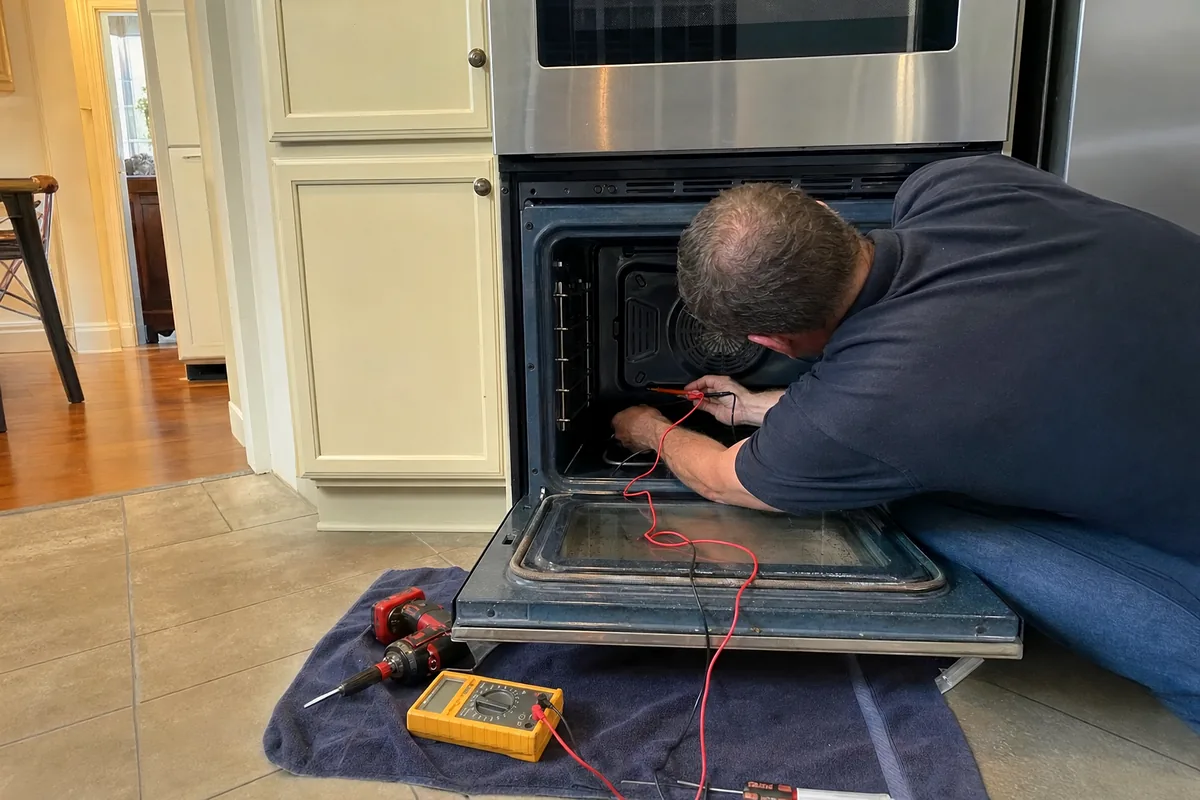
Meter leads clipped to a sensor inside an oven cavity, the clamp meter reading on the mat below
The dial says one number, the cavity holds another. Only one of them is measurable.

People almost always describe this the same way. The oven used to be ready by the time the tray was filled, and now it is not, and nothing else has changed. Sometimes there is a second half to the sentence: things brown on one side, or the top of a cake sets before the middle does.

Underneath that description there are only two possibilities, and they are worth separating because they lead to completely different repairs.

Possibility one: it is making less heat

An electric oven element does not always fail cleanly. It can open up in one section, keep glowing along the rest of its length, still feel hot to the hand, and be doing perhaps two-thirds of the work it used to do. Everything looks right and nothing is right.

The same thing happens more quietly with a temperature sensor. A sensor that has drifted a few degrees is not broken in any way you could see. It simply tells the control that the cavity is hotter than it is, and the control obediently stops calling for heat too early. The oven is then perfectly obedient and perfectly wrong.

Possibility two: it is losing heat

A door seal that has gone hard and taken a set will let a thread of heat out along one edge. You can often find it with the back of your hand held an inch from the door, moving slowly around the frame, while the oven is up to temperature. Where the air is warm, the seal has stopped sealing.

Hinges do the same thing more slowly. A hinge that has weakened lets the door sit a fraction proud at the top while still latching cleanly at the bottom, and the gap it opens is small enough to look like nothing and large enough to cost you fifteen or twenty degrees.

How we tell them apart

We put a measured temperature in the cavity and compare it with what the control believes. If the control is asking for 350 and the cavity is sitting at 320 while the element is still working hard, heat is going somewhere. If the element has stopped calling for heat while the cavity is still cool, the sensor is lying. That distinction takes one visit and it decides everything after it.

The third possibility, which is not really a third

There is a version of this complaint where the oven is neither making less heat nor losing it, and it is worth naming so you do not chase the other two for nothing.

If the cooking has changed rather than the oven, the symptoms can be identical. A heavier tray, a fuller oven, a dish going in straight from a cold refrigerator rather than from the counter, or racks loaded so tightly that air cannot move between them will all lengthen cooking times and produce uneven browning. So will a convection fan running slower than it should, which is a genuine fault but a mechanical one rather than a thermal one.

We mention it because it is easy to test at home. Preheat the oven empty, with one rack in the middle, and see whether it reaches temperature in something like the time it used to. If it does, the oven is fine and the loading is the variable.

Before you call

Two things are worth checking yourself, and both are free. Look at the door seal for a section that has flattened or hardened, and feel around the closed door for warm air while the oven is hot. If you find warmth at one corner, say which corner when you ring. It is the single most useful sentence you can give us.

oventemperaturedoor seal

The repair pages this belongs to

Every note on Wolf cooking faults · the feed

What does this cost to put right?

The diagnostic is $80, flat, and it comes off the bill. After that, the repairs we are actually called out to in Mandarin land between $180 and $680, parts and labour together. The firm figure is written down after the diagnosis and before anything is ordered.

Usual price ranges for Wolf cooking appliance repairs in Mandarin, Jacksonville, parts and labour together.
What turned out to be wrong Usual range
Diagnostic visit $80 flat, credited
Oven thermostat or temperature sensor $180–$560
Door hinge, glass or seal $190–$680

Ranges, not quotes. Two ovens with the same symptom can part company on the part number, and a retrofit opening can add an hour before a tool comes out of the bag. Nothing is ordered until the figure is in writing. The whole price page sets out how a job is priced.

Two questions this note raises

What does this usually cost to put right?
The visit and the diagnosis are $80 flat, and that comes off the bill if you go ahead. Oven thermostat or temperature sensor then usually lands at $180–$560, parts and labour together. Door hinge, glass or seal runs $190–$680. You get the figure in writing before a part is ordered.
How long is the work covered for?
Labour is warranted for 90 days and parts for 365 days, and the parts are genuine OEM. The cover is on the work we did and the part we fitted, not on a different fault that turns up later on the same appliance. Ring and say it is a warranty call: there is nothing for you to produce.

Every question we get asked on the phone

Owners who called about something like this

4.6 out of 5 from 75 published reviews

  • The grates were sitting proud on one side and the simmer burner would not hold a low flame. He levelled the unit in its cutout, cleaned the burner ports and set the low flame properly. It actually simmers now instead of going out.

    Hollis J.

  • The hood ran but the kitchen still filled up. He measured the pull, found the run above crushed where it turns, and was straight with me that the ductwork, not the hood, is the limit here.

    Barnaby S.

  • The middle burner would sputter and go out under a heavy pot. He found the orifice partly blocked and the flame spreader seated wrong from work someone else had done. He fixed both, then cooked on it with me standing there watching.

    Tessa L.

More of what owners said after the visit

Tell us what the range is doing

Describe the symptom in your own words. If it is something you can put right in ten minutes at the panel, we will say so on the phone and there is nothing to pay.

Call (904) 775-7957

A flat $80 covers the visit and the diagnosis, and it comes off the bill if you go ahead with the repair.

You get the price in writing before any part is ordered or any tool comes out of the bag.

Labour is warranted for 90 days and parts for 365 days, and the parts are genuine OEM.

Monday to Friday, 8:00am to 6:00pm. Saturday, 9:00am to 4:00pm. Closed Sunday.