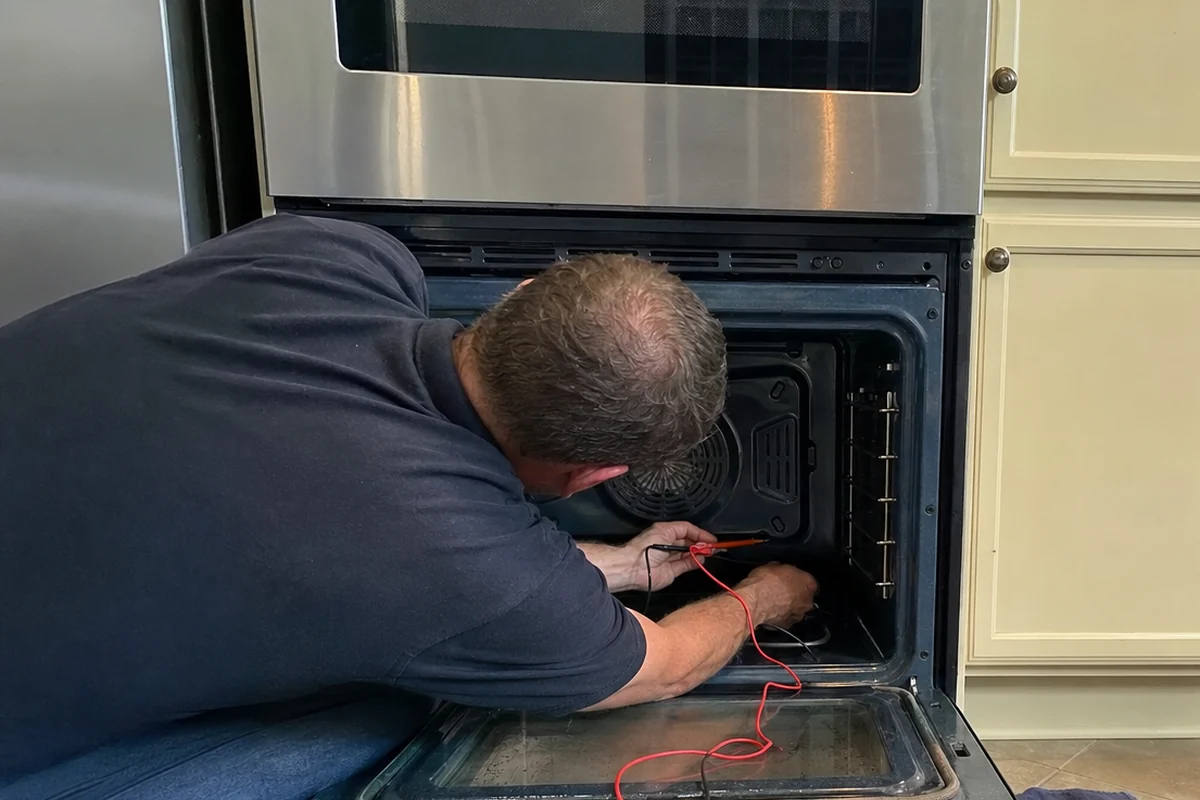
There is a version of this complaint that has nothing gradual about it. The oven is not slow and it is not uneven. You set it, the panel accepts the setting, something inside makes the noises it always made, and the cavity never warms up at all.
That is worth separating from the slow version, because an oven that runs cold is a heat-balance problem and this is not. An oven that will not heat is a question about whether anything is asking for heat in the first place.
The first ten minutes are yours, and they are free
People ring asking how to reset it, so here is the honest answer: there is no secret sequence. What exists is cutting the power at the breaker, leaving it off for a full minute and putting it back on. That clears a control that has latched into a state it cannot get out of, and it is the one thing worth trying before you pay anybody.
It is also a diagnosis in itself. If the oven heats afterwards and then stops again a week later, the fault is intermittent and electrical, and saying that on the phone is worth more than any model number. If nothing changes, the breaker trick has cost you nothing and ruled something out.
The lock that impersonates a dead oven
Before anybody talks about elements, the door latch gets checked. An oven that has been through a cleaning cycle and has not released the latch properly will refuse to heat, and it refuses politely: the panel takes the setting, the countdown runs, and nothing happens.
It is one of the most common causes of a completely cold oven and one of the cheapest to put right, which is exactly why it gets looked at before anything is ordered. A latch motor that stalled halfway leaves no trace on the display.
Gas and electric fail differently here
On the electric side of a dual fuel range, or in a built-in oven, an element that has failed open is silent. It looks exactly like an element that works. The meter settles it in a minute and nothing else does.
On the gas side there is no bake element to test at all, so the sequence is different: is the valve being asked to open, is the igniter drawing enough current to make it open, and is it doing that every time or only when it feels like it. A gas oven that will not light and a gas oven that lights on the third attempt are the same fault at two stages.
When it is the control
The control board is the last thing on the list, not the first, and we treat it that way on purpose. It is the dearest part on the appliance and it is the easiest one to blame, because a board explains any symptom you like.
It does genuinely fail here, though, and the reason is local: this is a part of Jacksonville that gets a long run of afternoon storms every summer, and what they do to kitchen electronics is set out in the note on storms and control boards. If your oven stopped heating within a week of a storm, say so when you ring. It changes what goes in the van.
What to tell us on the phone
Three sentences do most of the work. Whether the panel accepts the setting. Whether anything at all gets warm — the cavity, the vent above the door, the top of the range. And whether it had just finished a cleaning cycle, a power cut or a storm.
Those answers decide whether this is a ten-minute job at the latch, a measurement job at the element or the igniter, or a part on order. They also decide whether it is worth a visit at all, and we would rather say so on the phone than after one.