Jacksonville gets somewhere around sixty-eight thunderstorm days a year. That is enough that we treat electronic damage in a range or an oven as an ordinary repair rather than an unlucky one, and it is enough that the question “did this happen during a storm?” earns its place at the top of our phone call.
What people picture when they hear storm damage is a lightning strike, a bang, and a dead appliance. That does happen, and it is rare. Almost everything we actually see is smaller, quieter and more cumulative than that.
Three different events, one word
A direct or nearby strike is the dramatic case. Energy arrives through the service drop or through the ground, and it destroys whatever is in its path. The damage is usually obvious and usually not confined to one appliance.
Far more common is the induced surge. A strike a few streets away couples energy into the wiring of your house without ever touching it. What arrives at the appliance is a spike measured in microseconds, far too brief to trip anything, and quite sufficient to punch through the insulation of a small semiconductor.
Most common of all, and least discussed, is what happens when the power comes back. A restoration is not a clean event. Voltage sags, comes back, sags again, and switch-mode power supplies of the kind inside every modern appliance handle that badly. The board is trying to run properly on a supply that keeps changing its mind.
Why the appliance often fails later
This is the part that confuses people, and it is worth explaining because it affects whether they connect the two events at all.
A semiconductor damaged by a brief overvoltage does not always stop working. It frequently keeps functioning with a weakened junction, and then fails days or weeks later during an ordinary thermal cycle that it would have survived easily before. So the storm happens on a Tuesday, the oven is fine all week, and on Sunday afternoon it goes dark in the middle of a roast.
The owner reasonably reports that nothing unusual happened. From our side, the pattern of what has failed often says otherwise, which is why we ask about the past fortnight rather than only about today.
What partial failure looks like
Boards rarely fail completely. Far more often one section goes and the rest carries on, which produces symptoms that sound illogical from the kitchen and make perfect sense once the cover is off.
A display that lights up while nothing responds to it. An oven that will bake and will not broil, or the reverse. A range where the surface controls work and the oven is dead, or a convection fan that runs when it should not. A control that accepts a setting, holds it for a few minutes and then abandons it.
Any of those, following a storm within a couple of weeks, is worth reporting as a storm event even if you are not sure the two are connected.
What we check, and in what order
We do not start at the board, because the board is the expensive part and frequently not the failed one. We start upstream, at the supply, because a brownout or a loose connection can produce identical symptoms and will destroy a replacement board just as quickly as it destroyed the first one.
Then we check the protective components that exist precisely to fail first: fuses, thermal cutouts and the like. Those are cheap parts doing their job, and when one has done its job it usually explains the whole fault.
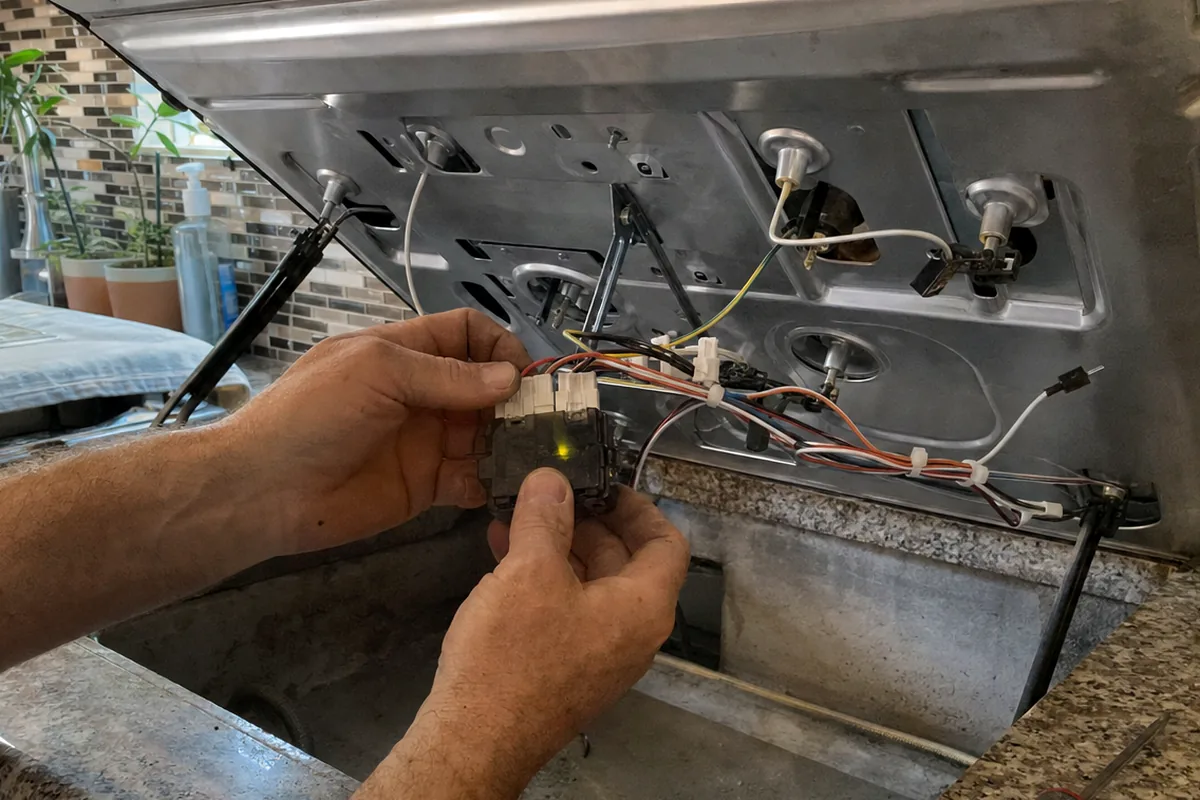
Only then do we look at the board itself, and when we do we look for the physical evidence a surge leaves behind rather than replacing on suspicion.
What actually helps
Two dull things, and we sell neither.
A whole-house surge protective device at the panel costs a great deal less than a control board for a large range, and it deals with the induced surges that cause most of what we see. It is not a guarantee against a direct strike, and nothing is.
The other is simply unplugging or switching off at the breaker when a serious storm is coming and you are home to do it. That is inconvenient advice and it is completely effective, and we offer it knowing most people will not take it.
Either way, if something failed and there was a storm in the last fortnight, tell us. It genuinely changes what we bring.