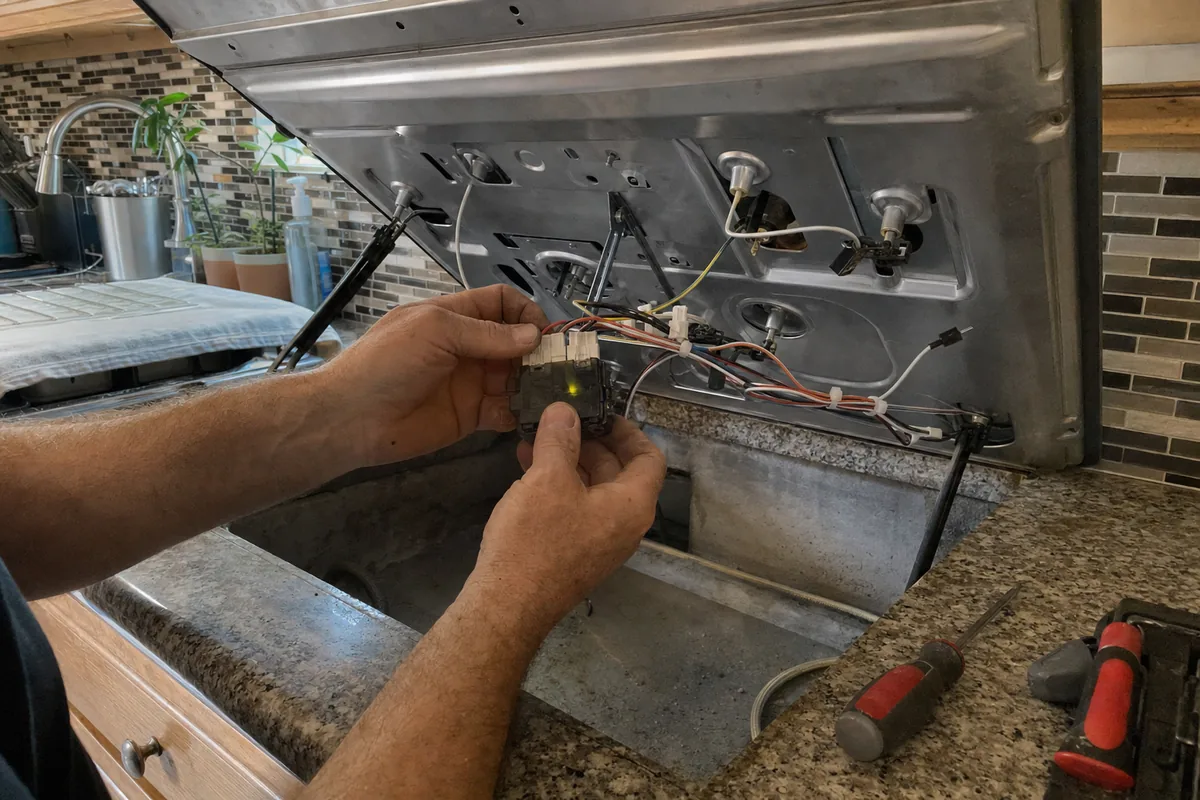
A burner that clicks and will not catch is the most common call we take, and it is also the one where a single sentence from the customer does most of the diagnostic work. That sentence is how many burners are affected.
One burner misbehaving while its neighbours light normally is a local fault, and the fault is within a few inches of the burner itself. Every burner clicking and none of them catching moves the question upstream to the gas supply. Those are two entirely different visits, and it is worth sorting out which one you have before you call.
When it is one burner
Three causes account for nearly all of it, and all three are small.
The first is a blocked port. Burners have a ring of small holes, and the ones near the electrode are the ones that matter for lighting. Something boiled over, ran into a port, and dried there. The burner will often still light on a high setting because enough gas gets out elsewhere and the flame travels round, and it will refuse on a low setting because there is not enough to start with.
The second is a cap sitting out of true. Burner caps have a seat, and they only work in one position. After a clean, a cap can go back a fraction proud or a few degrees rotated, and the ports are then no longer where the spark is jumping. The burner looks completely normal. It clicks and clicks and lights late or not at all. Lifting the cap and setting it down properly fixes an astonishing number of these.
The third is the electrode. It is a small ceramic-insulated pin sitting in the grease and steam of a working kitchen, and over time it picks up a film. The spark still happens and it is weaker, and a weaker spark lights cold gas less reliably. This is the cause behind the classic complaint of a burner that will not light first thing in the morning and behaves perfectly by lunchtime, because a cold kitchen is a harder place to light gas than a warm one.
When it is every burner
If nothing on the top will light, look at what else in the house uses gas. If the water heater is also cold, the problem is not the range and the call should go to the gas utility rather than to us.
If everything else is fine and only the range is affected, the question is whether the range is getting the pressure it needs. That is not something to assume from the meter, because a regulator that has drifted low will still keep a water heater and a thirty-inch cooktop perfectly happy and still starve a large range. We measure it at the appliance.
There is one more possibility worth naming, which is that the range is not getting any spark at all rather than not getting gas. If you can hear clicking, there is a spark module working. If there is no clicking anywhere, the module or its supply is the place to start, and that is an electrical fault on a gas appliance.
Clicking that will not stop
A separate complaint, and a common one: the burner lights normally and the clicking carries on afterwards.
On these appliances the same electrode that lights the flame is often used to confirm that the flame exists, by passing a very small current through it. A lit burner conducts. If the electrode is dirty, wet or bent slightly away from the flame, the control cannot detect the flame it just lit, so it keeps trying.
It is harmless and it is maddening, and it is usually cured by cleaning the electrode back to bare ceramic and metal and checking its position relative to the burner.
The simmer that will not hold
Last, the fault that is not really an ignition fault at all. A low flame has very little energy holding it to the port, so anything that disturbs it puts it out, and the causes stack rather than acting alone.
A slightly blocked inner ring, plus a supply pressure that has drifted a little low, plus a low-flame adjustment that was never set for this house, will together kill a simmer that would have survived any two of the three. That is why we check all three rather than adjusting the first thing we find. Fixing one of them can make the simmer hold on a cool morning and fail again in August, and then everybody has wasted a visit.