Repair
Wolf rangetop burners in Mandarin that click and will not light
A rangetop drops into the counter with cabinetry underneath, so everything that fails is within arm's reach once the grates and burner bowls come off.
What people describe when they call
- A burner takes several seconds of clicking before it catches
- The clicking carries on after the burner has already lit
- One burner will not go low without going out
- A griddle or grill module heats unevenly across its surface
- Grates rock slightly and pans sit off level
- A burner cap is discoloured on one side only
What the visit involves
- Lift the grates and bowls and inspect every port and cap seat by hand
- Set the electrode gaps and clean the spark path back to bare ceramic
- Check supply pressure at the appliance under full load, not at rest
- Verify the low-flame adjustment on each valve rather than guessing at it
- Check the surface temperature of a griddle module across its whole plate
- Give you a written price before any part is ordered
Kitchen cooking appliances, and only those. Not home heating · air conditioning · heat pumps · HVAC ductwork · water heaters · refrigeration · dishwashers · laundry.
A rangetop is the cooking surface on its own, dropped into a countertop cutout with cabinetry or a separate wall oven doing the rest of the work. It has no oven cavity, no oven door, and no oven electronics, which removes about half the things that can go wrong with a range and concentrates the rest into a shallow box you can get at from above.
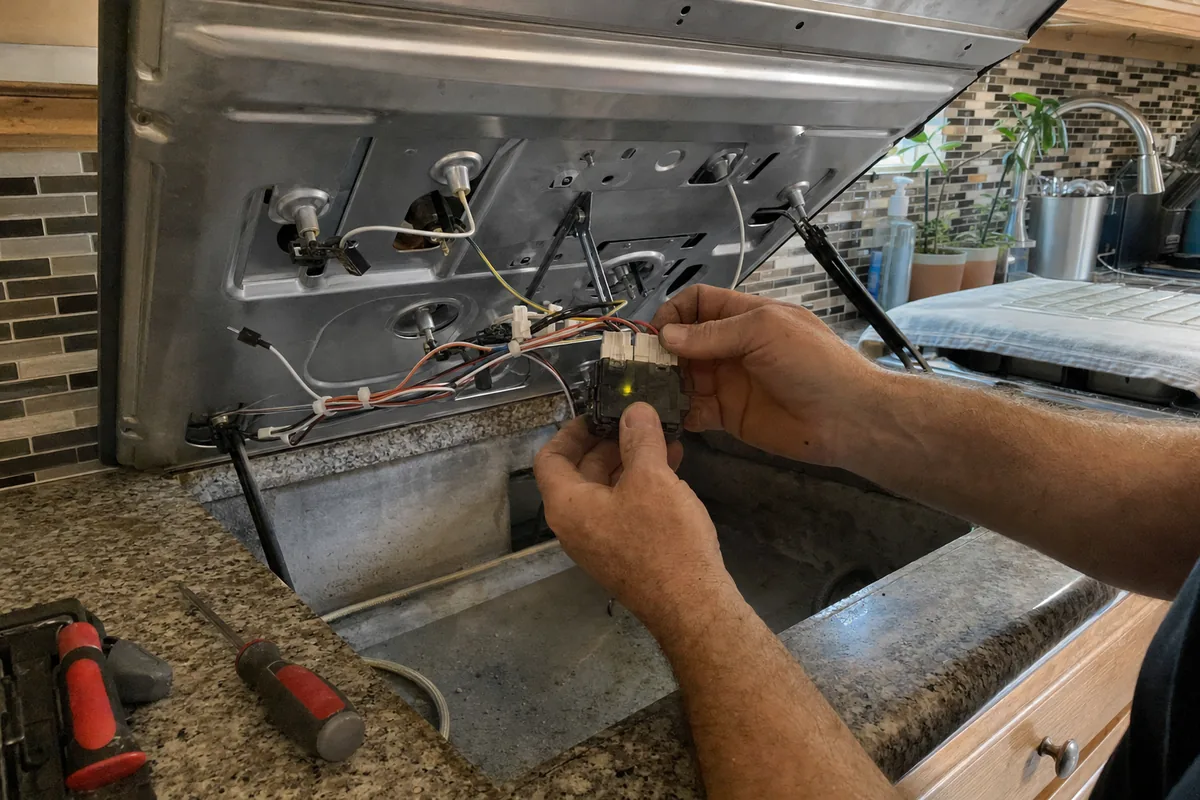
That accessibility is genuinely useful. Once the grates and the burner bowls come off, almost every part that fails on a rangetop is visible and reachable without pulling the appliance out of the counter, and a first visit can often be a repair rather than a survey.
Ignition that hesitates
The most common complaint by a wide margin is a burner that takes too long to light. Somebody turns the knob, the clicking starts, and instead of catching in a second or so it clicks for four or five seconds before the flame runs round the ring.
Three things cause almost all of it. The spark electrode may have picked up a film of cooked-on grease, which does not stop the spark but weakens it. The burner cap may be sitting a fraction out of its seat, which moves the ports away from where the spark is jumping. Or one or two ports near the electrode may be partly blocked, so the gas that should be arriving right where the spark is arriving somewhere slightly else.
There is a related complaint worth naming separately, which is clicking that carries on after the flame is established. That means the flame is lit but the sensing side of the circuit is not being told so, usually because the sensing electrode is dirty, wet or bent away from the flame. It is harmless in the short term and irritating immediately, and it is a quick fix.
The simmer that will not hold
Wolf rangetops are bought largely for the low end of their range, and a low flame is the most delicate thing a burner does. There is very little heat at that setting to keep the flame anchored to the port, so anything that disturbs it puts it out.
The causes are cumulative rather than singular. A slightly blocked inner ring, plus a supply pressure that has drifted a little low, plus a low-flame screw that was never set for the gas this house actually runs on, will together produce a simmer that dies while it would have held on any two of the three. We check all three rather than adjusting the first one we find and calling it done.
Griddle and grill modules
Where a module is fitted in place of burners, the complaint is usually about evenness rather than about failure. A griddle plate that browns beautifully at the front and reluctantly at the back is either not sitting flat on its supports or is being asked to hold a temperature that its thermostat is no longer reading correctly. A plate that has warped will never come back, and we will tell you so rather than sell you a control part.
Grates, bowls and the small stuff
Rocking grates are worth mentioning to us. They are almost never a failure and they are frequently a symptom. A grate rocks because a bowl underneath it is distorted, because a foot has been lost, or because the rangetop itself is sitting slightly twisted in its cutout. That last one matters in Mandarin more than it might elsewhere, because so many countertop cutouts here were enlarged after the fact when a larger appliance went in. A cutout that was opened up by hand and never quite squared leaves the rangetop supported on three corners instead of four, and everything above it inherits the twist.
Discolouration on one side of a burner cap is another small tell. It usually means that side has been running richer than the other, which points back at seating or at a partly blocked port rather than at the cap itself.
What does rangetop repair repair cost in Mandarin?
The diagnostic is $80, flat, and it comes off the bill. After that, the repairs we are actually called out to in Mandarin land between $200 and $700, parts and labour together. The firm figure is written down after the diagnosis and before anything is ordered.
| What turned out to be wrong | Usual range |
|---|---|
| Diagnostic visit | $80 flat, credited |
| Igniter or spark module replacement | $200–$510 |
| Burner valve or orifice service | $220–$700 |
Ranges, not quotes. Two ovens with the same symptom can part company on the part number, and a retrofit opening can add an hour before a tool comes out of the bag. Nothing is ordered until the figure is in writing. The whole price page sets out how a job is priced.
Questions people ask about rangetop repair
- How much does rangetop repair repair cost in Mandarin?
- The visit and the diagnosis are $80 flat, and that comes off the bill if you go ahead. Igniter or spark module replacement then usually lands at $200–$510, parts and labour together. Burner valve or orifice service runs $220–$700. You get the figure in writing before a part is ordered.
- Is it worth repairing, or should the rangetop repair be replaced?
- On a built-in appliance the honest answer is usually repair, because replacing one means matching a cabinet opening, a gas run, a duct and a circuit that were all built around the old machine. We say so when a repair stops making sense, and we say it before you spend.
- Do I need the model number before I ring?
- No. A symptom in plain words is enough to start. The plate is usually behind the bottom drawer or inside the door frame, and reading it out saves a little time on the phone, but it is not a condition of the call.
Where this comes up most
The parts of the service area where this fault turns up often enough to be worth a page of its own.
- Wolf ranges retrofitted into Mandarin kitchens drawn for something smallerMandarin · 32223
- Wolf induction ranges in Loretto, and the long run back to the panelLoretto · 32223
- Getting a Wolf 48-inch range down a Mandarin Road drivewayMandarin Road · 32223
Notes on this
Longer reading on the same faults, written in plain words.
- The hood that was never really ductedThe blower spins, the noise is convincing, and the kitchen still smells of dinner in the morning. Almost every time, the appliance is fine and the path out of the house is not.
- A burner that clicks and will not lightThe most useful thing you can tell us about a burner that will not light is how many of its neighbours are doing the same thing, because that single fact splits the diagnosis.
What owners said about rangetop repair
4.6 out of 5 from 75 published reviews
The grill module on the rangetop had stopped heating evenly across its width. He replaced the element and set the plate back dead level, and it browns from edge to edge again.
Adaeze O.
The charbroiler had stopped lighting at one end. He cleared a blocked port, changed the igniter on that side and ran it up to full to be sure it stayed lit before writing anything down.
Clementine J.
Our rangetop sits on an island wired long after the house was built, and the ignition would cut out whenever the disposal ran. He proved where the fault really was and told me who to ring, instead of selling me parts.
Dietrich W.
Tell us what the range is doing
Describe the symptom in your own words. If it is something you can put right in ten minutes at the panel, we will say so on the phone and there is nothing to pay.
A flat $80 covers the visit and the diagnosis, and it comes off the bill if you go ahead with the repair.
You get the price in writing before any part is ordered or any tool comes out of the bag.
Labour is warranted for 90 days and parts for 365 days, and the parts are genuine OEM.
Monday to Friday, 8:00am to 6:00pm. Saturday, 9:00am to 4:00pm. Closed Sunday.